

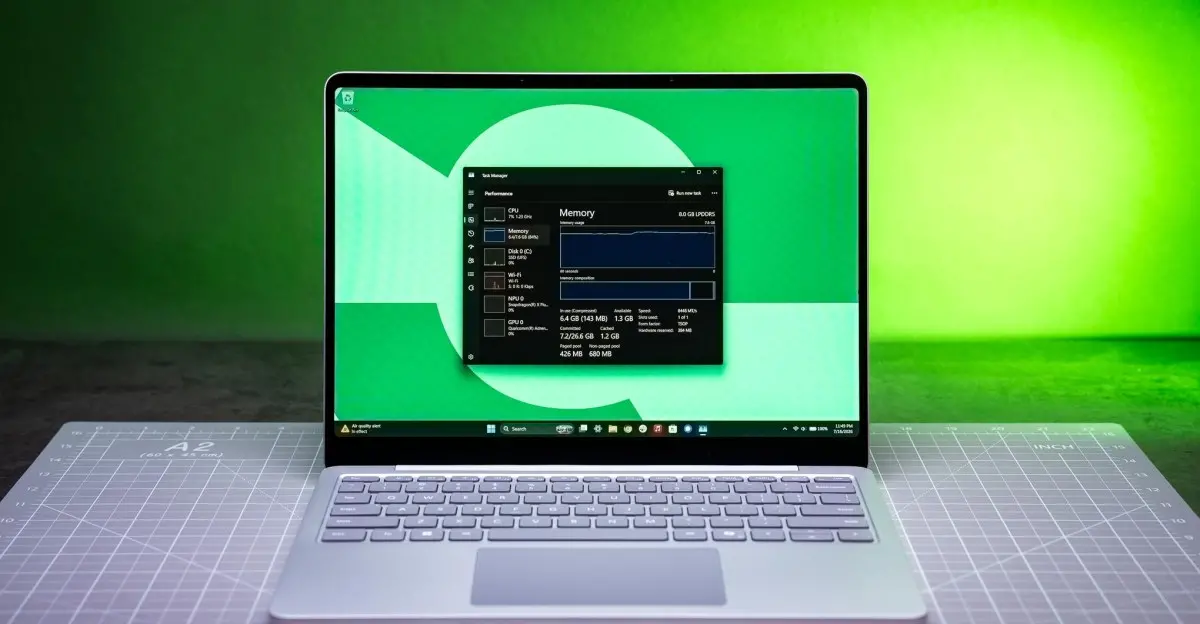
Microsoft recently refreshed its Surface Laptop 13-inch line with a new entry-level configuration that cuts RAM in half while raising the price. The $950 model comes with 8GB of memory, a significant reduction from last year's 16GB baseline. The move is a direct consequence of the ongoing global RAM shortage—dubbed “RAMageddon”—which has seen memory prices soar due to AI-driven demand. But as our testing reveals, even Microsoft’s own hardware struggles to deliver a smooth Windows 11 experience with so little memory.
The 2026 Surface Laptop otherwise inherits the same excellent design as its predecessor: a sleek aluminum chassis, a comfortable keyboard, a responsive trackpad, a sharp 1080p webcam, and outstanding battery life that easily lasts a full workday. The processor, an eight-core Snapdragon X Plus, is nearly identical to last year’s chip and even offers a slightly higher boost clock. But the bottleneck is clear: 8GB of RAM is insufficient for modern multitasking on Windows 11.
Real-world performance falls short
During everyday use, the 8GB Surface Laptop exhibited frequent, multi-second freezes. In one test, a Microsoft Teams call with a streamed video caused the system to hang for several seconds—despite the webcam being off and only about 10 Chrome tabs open across two virtual desktops, plus Slack and Signal running. Similar stutters occurred when editing Google Docs without any other demanding apps active. These freezes happened several times per day, which is unacceptable for a $950 laptop.
Task Manager revealed the root cause: available memory was almost always at 6.7GB out of 7.6GB usable. After a fresh reboot with minimal startup apps, Windows 11 consumed 4.2GB of RAM—nearly the minimum required by the OS. With just six Chrome tabs and no messaging apps, memory usage dropped to 5.5GB, but that left little headroom for anything else. Users would have to constantly monitor and limit their workload, which is not practical for a modern computing device.
Comparison with competitors
Apple’s MacBook Neo also ships with 8GB of RAM but handles multitasking better. In side-by-side testing, the Neo could manage more concurrent apps without stuttering. It also costs $250 less than the Surface Laptop, even after Apple’s recent price increase. While the MacBook Air with 16GB remains the gold standard for smooth performance, the Neo proves that efficient memory management can make 8GB work—at least for now.
Other Windows OEMs are also releasing laptops with 8GB RAM, including models from Dell, Acer, and Asus announced at Computex. With the RAM shortage expected to last years, 8GB will become increasingly common in entry-level systems. But if Microsoft itself cannot optimize Windows 11 for 8GB, other manufacturers face an uphill battle. The Surface Laptop’s struggles highlight a fundamental issue: Windows 11’s memory footprint has grown alongside its feature set, leaving little room for multitasking on low-RAM configurations.
Historical context and future outlook
Three years ago, 8GB was considered the minimum for a Windows laptop. At that time, most reviews recommended 16GB for power users. Since then, operating systems and applications have become more memory-hungry. Browsers like Chrome can easily consume 2GB with a dozen tabs. Productivity suites, video conferencing tools, and background services all demand more RAM. Meanwhile, the RAM shortage has reversed the trend of falling memory prices. SSD prices have also spiked, making 256GB storage feel cramped.
The Surface Laptop’s 256GB UFS storage is slower than NVMe SSDs found in many competitors. While it’s adequate for basic file storage, users who need to install large applications or work with media files will quickly run out of space. The combination of low RAM and limited storage makes the base model unsuitable for anything beyond light web browsing and document editing.
Microsoft has stated its commitment to improving Windows 11 performance on lower-cost hardware, especially to compete with Chromebooks and the MacBook Neo. However, our testing suggests that significant software optimization is needed before 8GB can be a viable option. The company’s own AI initiatives have contributed to the RAM shortage, as manufacturers prioritize high-margin AI hardware over consumer memory modules. This irony is not lost on reviewers: the same company pushing AI features is now releasing a laptop that struggles to run its own operating system smoothly.
What this means for consumers
For anyone in the market for a Windows laptop, the message is clear: avoid 8GB configurations unless your usage is extremely light. The $950 Surface Laptop with 8GB is not a good value when last year’s model with 16GB cost $900 and performed significantly better. The 16GB version of the current Surface Laptop costs $1,150, which is a much better investment for longevity. Alternatively, consider refurbished or open-box models of previous-generation laptops with 16GB RAM, or look into the MacBook Neo if you can tolerate macOS.
The RAM shortage shows no signs of easing. Prices could rise further, making 8GB laptops even more expensive. The current $950 8GB Surface Laptop might become a $1,050 or $1,200 model in the coming years. This new normal forces consumers to spend more for the same performance they had before. Until Microsoft and other OS vendors optimize their software for lower memory, or until the RAM market recovers, 8GB will remain a compromise that most users should avoid. The Surface Laptop’s excellent hardware is undermined by a single critical component, proving once again that RAM is the backbone of a responsive computing experience.
Source:The Verge News