

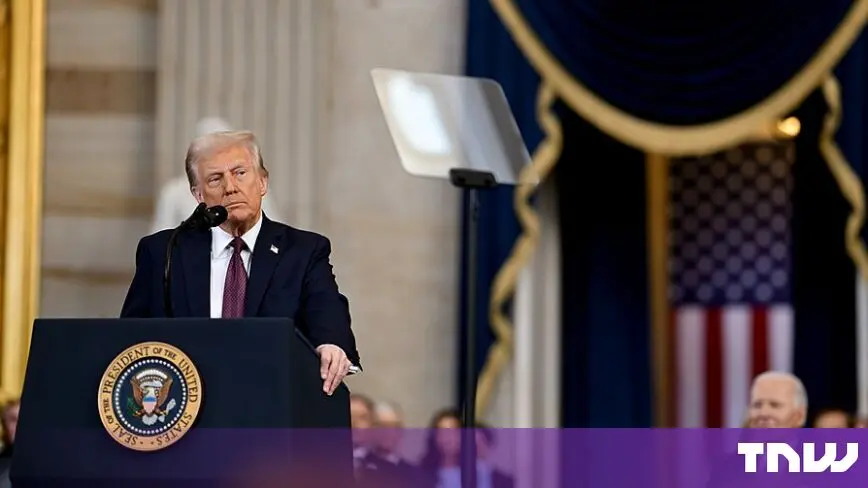
President Donald Trump is preparing to announce a $2.4 billion package of artificial intelligence tools and compute credits from five American technology companies, directing the resources toward federal scientific research. The announcement is expected Thursday at a White House summit titled Science: A New Golden Age. The pledge pulls together Nvidia, AMD, OpenAI, Anthropic, and Google, each committing a different share of cash-equivalent AI services, software, and cloud capacity. The beneficiaries are framed as the Genesis Mission, a federal effort to accelerate discovery across agencies and national laboratories.
The headline number is large enough to dominate the morning. Nvidia is contributing $1 billion, AMD $500 million, OpenAI $200 million, and both Anthropic and Google $150 million. The companies are not handing over unrestricted cash. The commitments take the form of AI tools and compute credits, meaning access to specialised hardware, model APIs, and cloud instances rather than a simple transfer to the US Treasury. That structure matters because compute is the scarce input in modern AI research: without it, models cannot be trained, simulations cannot run, and data cannot be processed at scale.
Who Is Giving What
- Nvidia: $1 billion in AI tools and compute credits, with its own share spread over five years across university research, quantum computing, and cloud providers serving government.
- AMD: $500 million.
- OpenAI: $200 million.
- Anthropic: $150 million.
- Google: $150 million, the smallest share among the five donors.
Michael Kratsios, the White House science policy director, said the commitments would channel billions across the science ecosystem. The language is expansive, but the practical effect depends on how federal agencies, universities, and national laboratories can claim the credits. The Genesis Mission is intended to connect AI capabilities to problems in biology, materials science, energy, climate, and national security. If the credits are usable, they could lower the barrier for academic groups that cannot afford commercial rates for high-end GPUs or inference. If they are not, the announcement remains a headline without a reservation system.
A Summit With Medals and Education Money
The summit is not only about corporate pledges. It also carries more than $100 million for science and engineering education, according to the announcement. The White House is using the event to celebrate prominent figures in technology and science. Elon Musk, Jensen Huang, Sergey Brin, and Lisa Su are expected to receive the National Medal of Science. Michael Dell is set to receive the National Medal of Technology and Innovation. The presence of those names gives the event a broadened political and cultural weight: the administration is presenting AI and advanced computing as central to American scientific leadership.
The ceremony also underscores how closely the federal government's science agenda is now tied to the commercial AI industry. The same companies that build and sell AI infrastructure are being asked to underwrite a portion of public research. That model can move quickly, but it also raises governance questions. When private firms donate credits, they retain control over the underlying infrastructure, the terms of use, and the priority rules. Public scientists may gain access, but they do not necessarily gain ownership or long-term capacity.
Microsoft Suspension Shadows the Summit
One guest had a complicated morning. Satya Nadella, Microsoft's chief executive, is being honoured at the summit. Hours earlier, the vice president and the labour secretary suspended Microsoft from a programme that lets employers sponsor foreign staff for permanent residency. Adobe and six IT services firms were also suspended, with alleged fraud cited as the reason. Capgemini, the only European name on that list, was not invited to Washington. The timing creates an awkward split-screen: Microsoft is celebrated for technology leadership while facing restrictions on its ability to sponsor immigrant workers for permanent residency.
The immigration programme matters to the technology industry because software, AI, and semiconductor firms rely heavily on foreign-born engineers and researchers. A suspension can disrupt hiring, retention, and long-term research teams. For Microsoft, which has major research operations and a large AI partnership portfolio, the move adds uncertainty. For the summit, it introduces a contrast between the administration's push to accelerate AI research and its simultaneous crackdown on a visa route that many technology companies use to keep specialised talent in the United States.
Compute Credits Are Not Reserved Capacity
Nobody has explained how the compute gets reserved. Credits are not capacity. A credit represents a promise of purchasing power or access, but the companies issuing them are also selling the same machine time to customers paying commercial rates. If demand for AI accelerators remains high, federal scientists could find themselves competing with better-funded corporate labs for the same clusters. The pledge does not automatically create new data centres, new power supplies, or new chips. It redirects access to existing or planned infrastructure, and the details of that redirection remain unclear.
The distinction between credits and capacity is central to whether the $2.4 billion figure translates into scientific output. A researcher needs more than a voucher. She needs a reliable allocation of GPU hours, storage, networking, software support, and technical staff. She needs to know when the compute will be available, for how long, and under what conditions. Without a queue reserved for federal science, the credits may be used only when commercial demand allows. That could mean off-peak access, older hardware, or limited inference budgets rather than the large-scale training runs that drive frontier results.
There is also the question of valuation. Companies can count in-kind contributions at list prices, but the actual marginal cost to the donor may be lower. A cloud provider with spare capacity may value a credit differently than a research university that must buy time at market rates. The announcement does not resolve how the $2.4 billion will be audited, whether it can be rolled over, or what happens if a company changes its internal priorities. Those are not minor accounting details. They determine whether the programme becomes a durable piece of science infrastructure or a one-time marketing exercise.
Why Compute Allocation Matters
Advanced AI research is capital-intensive. Training frontier models can require thousands of specialised accelerators running for weeks or months. Scientific computing has similar demands: molecular dynamics, climate simulation, fusion modelling, and genomic analysis all need massive parallel processing. When compute is scarce, researchers queue. When it is expensive, smaller institutions drop out. The result is a concentration of scientific capability in a handful of well-funded labs and corporate research centres. A federal programme that promises credits is trying to counteract that concentration, but only if the credits come with priority access and technical support.
The US also faces physical constraints. Data centres need power, cooling, land, and transmission. The most advanced chips are produced by a small number of foundries, and export controls shape who can buy them. Federal science competes not only with commercial AI labs but also with allied governments building sovereign compute capacity. In that environment, a donation of credits can be politically useful, but it does not change the underlying supply chain. The government would need procurement authority, long-term contracts, or direct investment to guarantee capacity for public research.
Britain Moves on the Same Companies
Britain spent the same morning on the same companies. The Information Commissioner's Office named Google, OpenAI, and Anthropic among ten developers from which it had secured changes after two years of scrutiny. The regulator also opened a call for evidence on how organisations manage the risks from AI agents. Three of the five donors in Washington, in other words, were simultaneously facing regulatory attention in London. The overlap is striking. It shows that the same firms being courted for voluntary scientific contributions are also subjects of formal oversight in another major jurisdiction.
The UK action focuses on data protection, transparency, and agentic AI risks. AI agents are systems that can take actions, use tools, and pursue goals with limited human input. Their risks include unauthorised data access, unintended transactions, and opaque decision chains. The call for evidence suggests regulators are trying to understand how organisations deploy these systems before setting rules. For Google, OpenAI, and Anthropic, the changes secured by the commissioner may be modest, but the scrutiny signals that AI safety and accountability remain live issues even as the US administration promotes a lighter-touch approach.
No Mandatory Guardrails
Trump has called AI safety concerns a hoax. Last week he and a group of AI executives signed an accord with no mandatory guardrails. Under that agreement, companies would work with outside auditors and tighten their own internal controls. The arrangement is voluntary. It does not impose civil penalties, licensing requirements, or independent testing mandates. It relies on reputational incentives and corporate self-governance. Critics argue that voluntary commitments are insufficient for systems that can affect national security, elections, health care, and financial markets. Supporters argue that mandatory rules would slow innovation and push development overseas.
The contrast with the UK's approach is sharp. London is extracting changes from developers and asking for evidence on agent risks. Washington is celebrating donations and voluntary audits. Both approaches are active at the same time, and the same companies operate under both. That dual exposure may shape corporate behaviour: firms may accept voluntary commitments in the US while making binding adjustments in Europe. The result could be a patchwork of obligations rather than a coherent global standard.
The Genesis Mission Already Had Billions
The Genesis Mission already had money. Reporting in July indicated that it had more than $5 billion behind it across fifteen agencies. Those funds were spread across federal programmes, national laboratories, and research initiatives. What the mission did not have, and still does not, is a guaranteed place in the queue for machines. The new $2.4 billion pledge adds to the financial total, but it does not resolve the structural bottleneck. Compute allocation remains the missing piece. Without reserved capacity, the mission depends on the goodwill and spare cycles of private providers.
The federal government has explored this problem before. The National AI Research Resource pilot and other efforts have tried to broaden access to AI compute for academics, small companies, and public-interest researchers. Those programmes face the same challenge: the most advanced chips are concentrated in a few commercial clouds, and demand outstrips supply. Government agencies can buy time, but they often compete with private labs that can pay more and plan further ahead. A donation model can help at the margin, but it does not create a public compute utility.
For scientists, the practical questions are immediate. Can a university team apply for a block of GPU hours for a six-month project? Can a national laboratory reserve inference capacity for a real-time experiment? Can a graduate student get access without a corporate sponsor? The announcement does not answer these questions. It provides a number and a list of donors. The implementation details, allocation rules, and oversight mechanisms are still to come. Until those exist, the $2.4 billion is best understood as a promise of access rather than a guarantee of capacity. The central unresolved issue is not whether the money is large, but whether the machines will be there when federal scientists need them.