

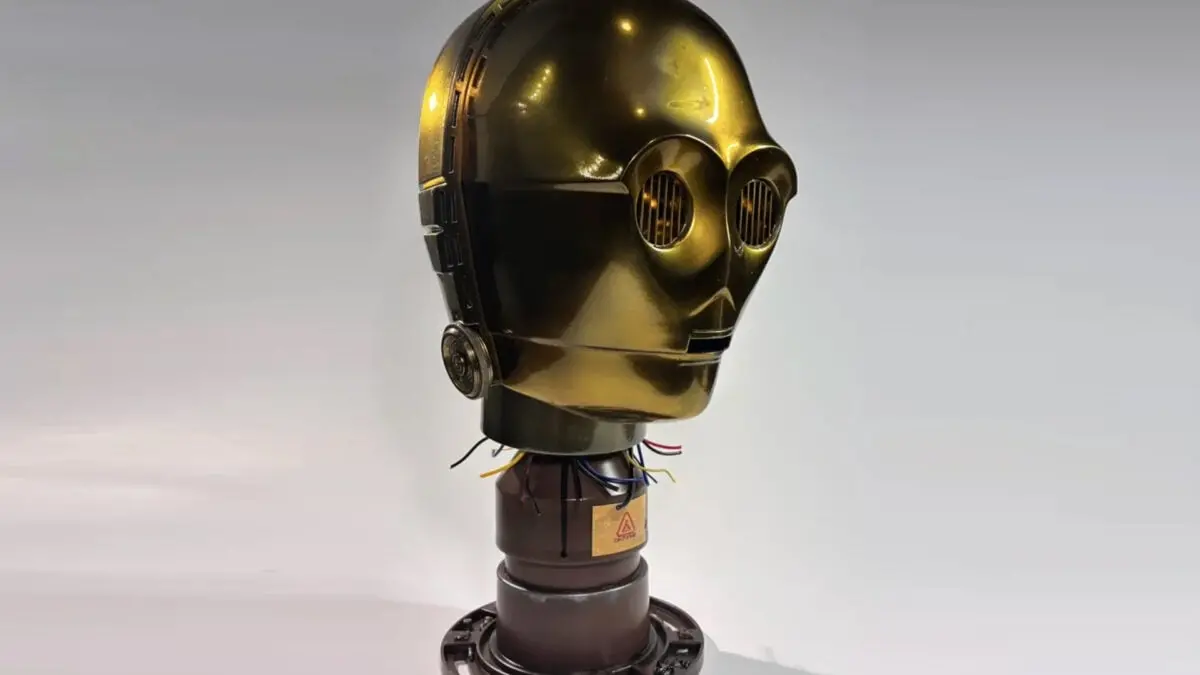
Build Your Own AI-Powered C-3PO Head That Talks Like the Real Droid
For decades, Star Wars fans have dreamed of owning a functional droid like C-3PO or R2-D2. While life-size replicas and animatronics exist, they often lack genuine interactivity. Now, a student at Chapman University in Orange County, California, has changed that by creating a C-3PO head that uses artificial intelligence to hold full conversations—and the best part is, you can build one yourself.
The project, detailed in a video and paper by Samuel Potozkin, demonstrates how a Raspberry Pi 5, a custom large language model (LLM), and sophisticated audio processing can transform a 3D-printed prop into a talking companion. Unlike simple voice assistants that give generic responses, this C-3PO head is imbued with the character's distinctive personality—prissy, polite, and slightly condescending—thanks to a fine-tuned LLM trained on dialogue from the Star Wars films.
Key Facts Behind the Build
At its core, the system uses a straightforward pipeline: a microphone captures the user's speech, which is sent to a Raspberry Pi 5. The Pi runs a real-time speech-to-text converter, transcribing the user's words into text. This text is then fed as a prompt to the custom LLM, which generates a response in C-3PO's voice. Finally, a text-to-speech system—enhanced with audio post-processing—outputs the reply through a speaker hidden inside the head.
Potozkin faced a significant challenge: the initial text-to-speech output sounded nothing like the metallic vocal tone of C-3PO. In his paper, he explains the audio processing he applied to achieve the correct timbre. He introduced a short delay line to create tightly spaced temporal reflections, simulating the echo of a metal chamber. He also applied a chorus effect by slightly modulating the time and pitch of duplicated signal paths, creating the impression of layered vocal resonance. The result is a voice that is immediately recognizable as Threepio, even without visual context.
The project took advantage of recent advances in on-device AI. The Raspberry Pi 5, released in late 2023, offers enough processing power to run a lightweight LLM locally, avoiding the need for cloud connectivity. This ensures low latency and privacy—no one listens to your conversations with the droid. The custom LLM was fine-tuned using dialogue from the original trilogy, as well as scenes from The Empire Strikes Back and Return of the Jedi, to capture C-3PO's unique patterns of speech, including his tendency to state the obvious and complain.
Background and Cultural Impact
The timing of Potozkin's project coincides with renewed interest in C-3PO memorabilia. Last month, the original head prop from The Empire Strikes Back (the one that gets separated from Threepio's body in Cloud City) sold for over $1 million at auction, making it one of the most expensive pieces of Star Wars merchandise ever. While that prop is now in a private collection, Potozkin's DIY version offers an accessible alternative for fans who want a piece of the galaxy far, far away on their coffee table.
C-3PO has always been a beloved but underappreciated character. Voiced by Anthony Daniels, the golden droid serves as a foil to the more pragmatic R2-D2, providing comic relief and cultural commentary. His prissy demeanor and insistence on protocol make him a memorable part of the Star Wars universe. Potozkin's project captures that essence, allowing users to experience what it's like to be R2-D2—constantly greeted by a stream of polite but exasperated chatter.
For those interested in replicating the build, Potozkin has published all the details on his GitHub page. The repository includes 3D printing files for the head, the code for the LLM and audio processing, and a list of required components. The total cost, excluding the 3D printer, is estimated at around $200—a fraction of the price of commercial animatronics or the auctioned prop. The project also highlights the growing maker movement, where hobbyists combine off-the-shelf electronics with AI to create interactive art.
Technical Deep Dive
The choice of the Raspberry Pi 5 is critical. Its quad-core Cortex-A76 processor and support for faster I/O allow real-time speech processing without stuttering. Potozkin selected a lightweight LLM—specifically, a quantized version of a model like Llama 2 or similar, fine-tuned on Star Wars dialogue. The speech-to-text engine uses an offline model (e.g., Whisper), ensuring everything runs locally. The audio post-processing is implemented in Python using libraries like PyAudio and librosa to apply delay, chorus, and EQ filters.
One interesting detail from the paper is the effort to match C-3PO's vocal cadence. The LLM is prompted with instructions to stay in character, avoiding modern slang or anachronisms. The text-to-speech engine is tuned to a higher frequency range, and the audio processing adds a metallic sheen. Potozkin notes that he experimented with multiple iterations before landing on the final setup, which he describes as "convincingly droid-like."
The physical head is 3D-printed using gold filament, with electronics housed inside a removable brain cavity. A small speaker and microphone are hidden behind the mouth grille, and the eyes are LEDs that flash in rhythm with speech—another software-controlled touch. The entire assembly is lightweight enough to sit on a shelf or desk, and it can be powered via USB-C.
Star Wars Day and Beyond
Published on May 4—Star Wars Day, of course—the project has already attracted attention from both tech and fan communities. It exemplifies how AI can be used to breathe life into beloved characters without requiring Hollywood budgets. Potozkin's work also opens the door to other character-driven projects: imagine a talking Yoda head that dispenses wisdom, or a droid that recites lines from the films on demand.
The timing of the release is no accident. Star Wars Day ("May the Fourth be with you") has become an annual celebration for fans, marked by merchandise sales, film marathons, and fan projects. Potozkin's C-3PO head offers a new way to celebrate: by having a conversation with a character that has entertained audiences for nearly 50 years. As the LLM learns from interactions, the droid could even develop personalized responses for repeat users.
For those worried about the ethical implications of AI impersonating fictional characters, Potozkin's project stays firmly in the realm of fan tribute. The LLM is trained only on publicly available dialogue and does not attempt to mimic real people. It is a tool for creative expression, much like a costume or a prop replica. And it demonstrates that AI, when used thoughtfully, can enhance rather than replace human creativity.
The project also touches on the future of smart home devices. Instead of a generic assistant like Alexa or Siri, users could have a character-based interface that adds personality to everyday interactions. While Potozkin's C-3PO head is primarily a novelty, it hints at a future where our devices are not just functional but also entertaining and emotionally engaging.
From a technical standpoint, the pipeline is open-source and adaptable. Hobbyists can replace the C-3PO personality with any character they have dialogue for. The audio processing can be modified to match different robotic voices, such as the monotone of R2-D2's beeps or the gravelly tone of K-2SO from Rogue One. The possibilities are limited only by available data and the user's willingness to fine-tune the model.
Potozkin's video shows a sample conversation where he asks the head about its day, and it responds with complaints about "sand" and "protocol violations." The delivery is spot-on, complete with pauses and inflections. The head even seems to have a sense of humor—when asked if it likes R2-D2, it replies with a reluctant "I suppose he is tolerable."
The project has also sparked discussions about the preservation of character voices. As original actors age, AI could be used to keep characters alive in future media, though this raises legal and ethical questions. Potozkin's work is a harmless example of using AI for nostalgia, but it highlights the technology's potential—and its pitfalls.
For now, the C-3PO head is a testament to what a single motivated maker can achieve with modern hardware and open-source AI. It is a perfect blend of craftsmanship, programming, and fandom. And as Potozkin notes, anyone with basic soldering skills and a few weekends can join in.
Whether you place it on your desk, your bookshelf, or next to your home theater, this AI-powered Threepio is sure to be a conversation starter. Just be prepared for it to comment on everything from your choice of music to the state of your living room. After all, C-3PO is never short of opinions.
Source:Gizmodo News