

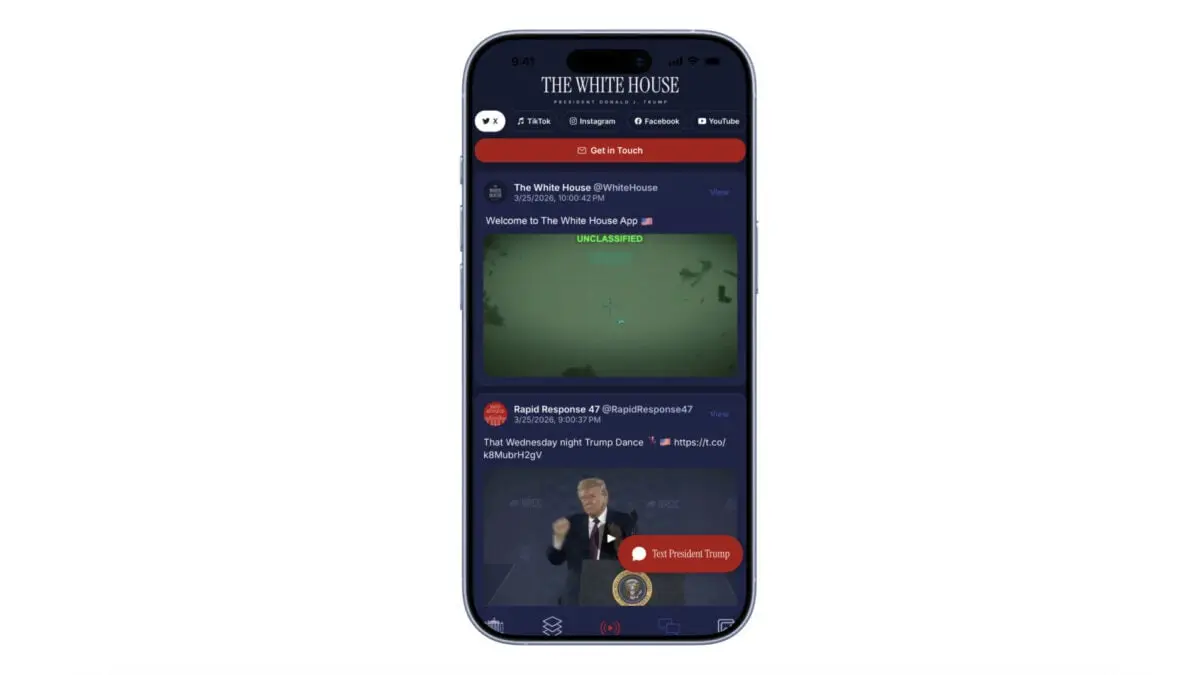
The White House has announced that its official mobile application will soon be automatically installed on all mobile devices used by employees of the Department of Homeland Security. The app, which was first released for voluntary download in March, promises to deliver what it describes as "unfiltered, real-time updates straight from the source"—referring directly to President Donald Trump. According to an internal email obtained by Politico, the app is being positioned as a convenient way for DHS staff to receive official communications, including announcements, executive actions, speeches, livestreams, videos, and other priority updates. This move mirrors a similar initiative that began with the Federal Aviation Administration last month, when the Trump administration instructed federal agencies to begin installing the app on agency-issued phones. Now, DHS becomes the latest — and one of the largest — agencies to receive the application as a mandatory auto-download.
The app was originally launched in the spring and made available through both Apple's App Store and Google Play. Its feature set includes breaking news alerts, a video streaming function, a library of archived speeches and sound bites from President Trump, tools to "stay connected" with new policies, and a voice-enabled feedback option. However, critics have quickly pointed out that the app's data-sharing practices are unusually opaque. According to a report by Notus.org, the White House app collects user data such as time zone, IP address, and device identifiers, and shares this information with third parties — but it does not disclose these practices in the standard clear manner required by most privacy guidelines. The lack of transparency has raised alarms among cybersecurity experts and privacy advocates, who argue that forced installation on government devices could open the door to broader surveillance or even security breaches.
Former General Services Administration IT executive Sonny Hashmi told Government Executive that auto-installing the app on government-issued devices is "cause for alarm." Hashmi warned that any app installed on a device connected to a government network could potentially create backdoor access behind the firewall. "If the app has any vulnerability or if its data-sharing permissions are abused, it could become a vector for malicious actors," Hashmi explained. "This is not just about privacy — it's about the integrity of government networks." The concern is compounded by the fact that DHS is responsible for border security, cybersecurity, and disaster response, making any potential breach particularly sensitive.
The forced installation also invites comparisons to previous high-profile auto-downloads, such as Apple's infamous U2 album release in 2014, when the band's album "Songs of Innocence" was automatically added to every iTunes library. While that was a marketing mishap, the White House app represents a deliberate policy decision by the executive branch. The administration argues that the app provides a direct line of communication to federal employees, ensuring they receive official messaging without relying on third-party media outlets. However, critics counter that the app effectively turns DHS employees into a captive audience for political content, blurring the line between government business and political promotion. The app's promotional materials emphasize "breaking news alerts on major announcements, executive actions, and other key priorities," which some interpret as a way to bypass traditional press briefings and deliver messages directly to federal workforce.
Historical context adds another layer to this story. The White House previously launched an official app in 2010 under President Barack Obama. That earlier app, while not without its flaws, was designed primarily to provide public access to White House schedules, press briefings, and photos. It was never forced onto government devices. The current administration's approach is markedly different in its scale and intent. According to Government Executive, the FAA was the first agency to receive the auto-download, with DHS now following suit. There are indications that other federal agencies may be next, with the administration encouraging widespread adoption across the entire executive branch. The Trump administration has also been known to push its own technology initiatives, including the development of a custom "Trump Phone" that was marketed to supporters as a secure device but was criticized as a gilded cage for outdated smartphone technology.
The privacy implications extend beyond just DHS employees. Since many government devices also handle sensitive data about citizens, any app with broad data-collection permissions could potentially expose personal information. The app's ability to send feedback via voice also raises concerns about whether conversations near the device could be recorded or analyzed. While the White House has not addressed these specific fears, the app's privacy policy — as reviewed by Notus — is described as lacking the standard transparency measures required by most mobile apps. This includes not providing clear opt-out mechanisms for data collection and not specifying how third parties may use the collected data.
Reaction among DHS employees has been mixed. Some see the app as a harmless tool for staying informed, while others are deeply uneasy about being forced to install software that may track their location, usage patterns, and preferences. One anonymous DHS official told Politico that the email announcing the auto-install was met with "confusion and irritation" because employees were not given a choice. The official noted that many DHS staff already receive official updates through secure internal channels; the app appears redundant at best and intrusive at worst. The comparison to the U2 album auto-install has become a running joke within some departments, but the underlying concerns are serious. "This isn't an album we can just delete — it's a piece of software that will remain on our phones," the official said.
Security researchers have also weighed in. Several have pointed out that forced installation of any app creates a new attack surface. If the White House app contains even a minor security flaw, it could be exploited to gain access to DHS networks. The fact that the app shares data with third parties introduces additional risk: any breach at a third-party data broker could expose government employee information. Moreover, the app's voice feedback feature could potentially be used to collect ambient audio, a capability that, if misused, would violate federal wiretapping laws. These concerns are not theoretical; in recent years, numerous government and corporate apps have been found to contain vulnerabilities that allowed unauthorized access to user data.
The broader political context cannot be ignored. The Trump administration has frequently clashed with mainstream media outlets and has sought to communicate directly with the public through social media and now through its own app. By forcing the app onto government devices, the administration ensures that federal employees receive its messaging without any editorial filter. Supporters argue that this is simply efficient communication; detractors see it as an attempt to create an echo chamber within the government. The app's "library" of what are described as archived Trump sound bites suggests the app is designed not only for news distribution but also for promoting the president's personal brand. This has led to questions about whether taxpayer-funded devices should be used to disseminate content that may be perceived as political campaign material.
Looking ahead, the forced installation on DHS devices is likely to face legal challenges. Privacy groups and civil liberties organizations have already begun examining whether the move violates the Privacy Act of 1974, which restricts how federal agencies can collect and use personal information. Additionally, the installation may run afoul of internal DHS policies that require software to be vetted for security and privacy compliance. The Government Accountability Office may also investigate whether the app meets federal cybersecurity standards. For now, however, DHS employees are being told to expect the app to appear on their devices in the coming weeks, with no option to decline. As one former IT official put it, "This is a test of how far the administration is willing to go to control the narrative — and of how much resistance it will face from within the federal workforce."
Source:Gizmodo News