

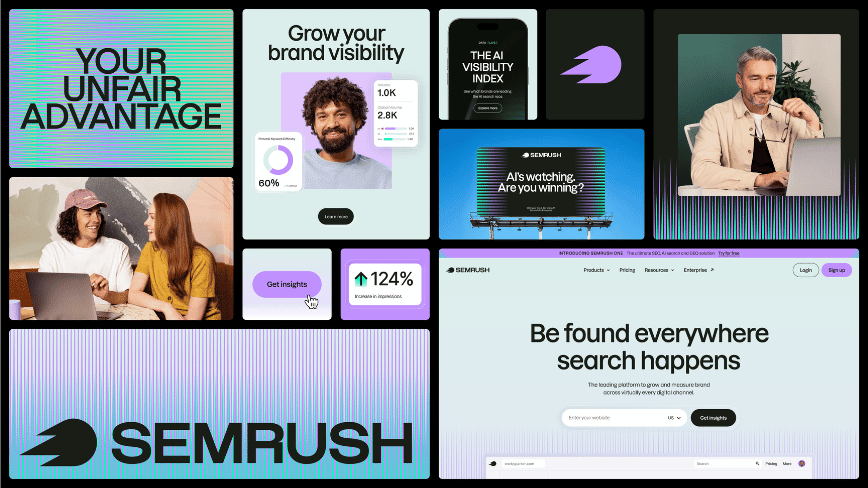
Summary: Semrush has launched a Brand Visibility Framework at Adobe Summit, introducing 'Agentic Search Optimisation' to measure brand presence across AI-generated answers and traditional search. This initiative comes as organic click-through rates have significantly declined, with many brands becoming invisible to generative AI.
At the recent Adobe Summit in Las Vegas, Semrush unveiled its Brand Visibility Framework, a strategic model aimed at assessing how brands are discovered across traditional search engines, AI-generated responses, and autonomous AI agents. This framework presents 'Agentic Search Optimisation' as a new discipline, leveraging a database of over 213 million large language model prompts to highlight how brands are perceived and mentioned within systems that bypass direct link clicks.
This launch is timely, coinciding with Semrush's ongoing $1.9 billion acquisition by Adobe, announced in November 2025 and expected to finalize in the first half of this year. The framework positions Semrush within Adobe's marketing stack, addressing the evolving landscape of brand visibility as AI technologies reshape search methodologies.
The Challenges Addressed by the Framework
The data supporting this framework reveals a troubling trend for businesses reliant on organic search traffic. A Gartner prediction from February 2024 indicated a potential 25% decline in traditional search engine volume by 2026, driven by the rise of AI chatbots and virtual agents. This shift is evidenced by the fact that Google’s AI Overviews now appear on 48% of tracked search queries, marking a 58% year-over-year increase. Additionally, organic click-through rates have plummeted by 61% for queries featuring AI Overviews, while paid search click-through rates have dropped dramatically from around 11% to just 3% within a single month last year.
Furthermore, zero-click searches—where users receive answers without visiting websites—rose from 56% to 69% of all queries between May 2024 and May 2025. Notably, ChatGPT has amassed 800 million weekly active users, and Perplexity processed 780 million queries in May 2025 alone. Although traffic from AI search boasts a conversion rate of 14.2%, compared to just 2.8% from traditional Google searches, the volume of such traffic remains significantly lower, leaving brands with limited control over their visibility within AI systems.
The research underlying the framework highlights a stark contrast between investment in traditional SEO and actual visibility in generative AI. While 94% of brands invest heavily in conventional SEO, 62% are deemed 'technically invisible' to these AI models. Only 8% to 12% of the results appearing in AI-generated answers overlap with those that rank well in traditional search, indicating that SEO practices do not reliably translate into visibility in AI-informed systems.
Framework Proposals and Implications
Semrush defines brand visibility as 'the degree to which a brand is discoverable, authoritatively represented, and commercially actionable across both human- and machine-mediated discovery surfaces.' The framework consists of a two-part research series: one focused on executing the Brand Visibility Operating Model and the other providing strategic insights for chief marketing officers navigating AI search.
The core operational element is Agentic Search Optimisation, which Semrush distinguishes from traditional SEO. Unlike SEO, designed for human users scanning links, Agentic Search Optimisation caters to AI agents that assess brand relevance and authority, offering recommendations without presenting alternatives. This distinction is crucial, as AI systems synthesize information from various sources rather than ranking web pages in a traditional sense.
The framework builds upon Semrush’s AI Visibility Index, launched in October 2025, which tracks brand mentions, positioning, website citations, and share of voice across platforms like ChatGPT and Google AI Mode. This index serves as a 'keyword research for AI,' mapping user inquiries directed at AI systems rather than conventional search engines.
Commercial Context and Future Directions
In its fiscal report for 2025, Semrush reported $443.6 million in revenue, an 18% increase year-over-year, with annual recurring revenue reaching $471.4 million. The standout figure, however, is the remarkable growth in AI product revenue, which surged to $38 million from just $4 million the previous year, marking an impressive 850% growth. The number of customers spending over $50,000 annually also rose by 74%.
The acquisition by Adobe, valued at $1.9 billion, underscores the strategic alignment: while Adobe offers tools for content creation and delivery, it lacks a comprehensive understanding of content discoverability. Semrush's Brand Visibility Framework effectively fills this gap, providing a foundational structure for integration into Adobe's product line.
As the industry adapts to these changes, Semrush is not alone in recognizing the shift. Competitors like Ahrefs and Moz Pro are enhancing their offerings with AI visibility features. Startups like Lemrock are developing commerce layers for AI agents, bridging connections between retailers and various AI platforms. Brands are already feeling the impact, with some reporting traffic declines of up to 30% as user queries migrate from Google to AI-based systems.
In conclusion, the framework's findings highlight an organizational challenge, as teams that align their SEO and AI strategies report significantly more measurable and actionable brand visibility. The evolving landscape indicates that the ability to manage visibility across different systems is crucial for brands aiming to thrive in this new era of AI-driven discovery.