

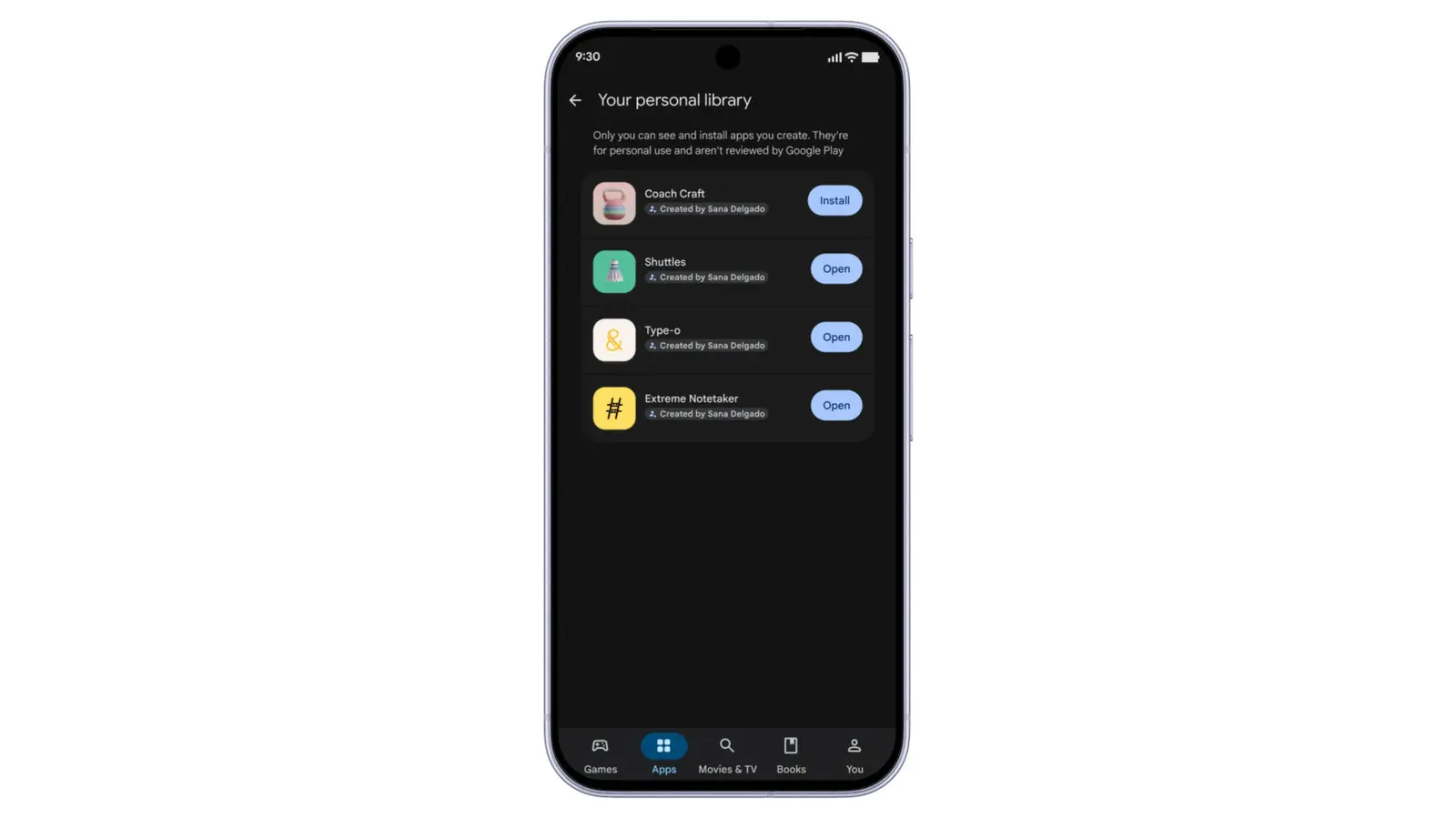
Google announced on Oct. 13, 2026, a major expansion of Play Store publishing rules that will allow people who create Android apps with AI-assisted tools to distribute those apps using only a Google account. The change is aimed at the growing wave of vibe-coded software—apps generated through natural-language prompts and light editing rather than traditional development workflows. It will roll out to users in the United States and other select markets who are 18 and older.
Under the new process, users can upload a vibe-coded Android app from Google AI Studio without a paid developer account. AI Studio can generate an app from a written prompt to Gemini, and creators can refine the result with more prompts or by editing the generated code directly. That lowers a barrier that has historically kept casual creators, hobbyists, and first-time builders out of the Play Store ecosystem.
A Lower Barrier to Play Store Publishing
Android has long allowed users to sideload APK files onto phones and tablets, but Google has made that process more complex over the past year. The new publishing route is designed to make distribution easier while keeping it inside Google’s managed ecosystem. Instead of asking users to hunt for APK files or manage unknown-source permissions, Google will provide a consent-based path from AI Studio to the Play Store.
The initial scope is deliberately limited. An app will first appear only on the creator’s own devices, including tablets and computers with access to the Play Store, through a new personal library section. That approach lets Google test the publishing flow and safety model without immediately opening the global store to a flood of AI-generated apps. It also gives creators a private space to try an app before sharing it.
Google eventually plans to let users securely share vibe-coded apps with friends and family. That middle step matters because it could turn the Play Store into a lightweight distribution channel for personal projects, family utilities, classroom tools, and small experiments. It also creates a buffer between private use and public release. When a creator wants to reach a global audience, Google says it will be possible to graduate to a professional developer account and submit apps to the Play Store’s normal safety reviews.
From Personal Library to Professional Review
That graduation path is central to how Google is framing the change. The company is not eliminating its review system for public apps; it is creating a tiered model. Private or family-scale distribution can happen with fewer formal steps, while public distribution still requires the accountability and review processes that Google has built around the Play Store. The structure could reduce friction for beginners without abandoning the safety and policy checks that global distribution demands.
The model also reflects a broader shift in software creation. Generative AI tools are making it possible for people with limited programming experience to produce working apps from descriptions, screenshots, or iterative prompts. The results can be simple utilities, prototypes, games, or novelty apps. But AI-generated code can also contain bugs, security weaknesses, privacy problems, or policy violations. A tiered publishing system gives Google room to separate low-reach personal use from high-reach public distribution.
Google has been injecting AI into its products across search, productivity, and mobile software. The Play Store changes are part of that effort, but they also respond to competitive and legal pressure. Google has faced scrutiny over how it controls Android app distribution, and third-party app stores can now be installed through the Play Store in some contexts. By making the Play Store friendlier to small and AI-assisted creators, Google can argue that its store is more open while keeping the default distribution path inside its own ecosystem.
AI Studio Changes Who Can Build and Ship
AI Studio is central to the new publishing route. The tool is designed to turn a written prompt into an app, with Gemini handling the generation process. Creators can adjust results through additional prompts or by editing the code themselves. That flexibility is important: it means the process is not limited to a single automatic output. A creator can iterate, fix issues, add features, and shape the app before uploading it.
Still, the phrase vibe-coded signals both the promise and the risk. It describes a style of software creation that prioritizes momentum and experimentation over formal engineering discipline. That can be liberating for solo creators. It can also produce apps that are fragile, hard to maintain, or unclear about data handling. Google’s private-library phase and professional-review graduation path are likely meant to manage those risks without discouraging experimentation.
The change could also affect how people think about app stores. For years, the Play Store and Apple’s App Store have been gatekeepers with formal developer programs, fees, review queues, and policy manuals. AI-generated apps challenge that model because the cost of creating software is falling. If anyone with a Google account can publish to a personal library, the store becomes less like a curated marketplace and more like a distribution layer for personal software. The professional tier would remain for apps that seek a broad audience.
Discovery, Gemini, and the Search for Apps
Google is also revising how people find apps. At I/O 2026, the company introduced Ask Play, and it is now bringing similar discovery features to Gemini by allowing the AI assistant to surface direct links to Play Store apps in chats. That could change the path from a conversation to an install. Instead of searching the store manually, a user might ask Gemini for a tool, game, or utility and receive a direct app link in response.
Google is expanding its sports topic pages as well. These pages appear in the Play Store during live matches and will now cover soccer games from the Premier League, Major League Soccer, and more. The feature is designed to connect live events with relevant apps, games, and content. In cars with Google built-in and on Android XR, Google is updating the Play Store layout to better fit the size of the physical or virtual screen. That matters as Android expands beyond phones into vehicles and mixed-reality headsets.
Game Finder, Gamer DNA, and Playlists
For game discovery, Google introduced Game Finder, a feature that recommends games based on a user’s taste. The recommendations are powered by what Google calls Gamer DNA, a taste profile that users can fine-tune with preferences and favorite genres. During a press roundtable, Google suggested it hopes to make filters and genre tags increasingly granular. That could eventually allow users to search for games with specific features, such as controller support.
Google is also adding game playlists, which let users recommend a collection of mobile games for other people to try. The feature turns discovery into something more social and curated. Instead of relying only on algorithmic recommendations, players can share lists of games around a theme, mood, or play style. That could help smaller games find audiences through player recommendations.
New Tools for Game Developers
Google is updating the experience of playing games on Android too. The Sidekick overlay now has a feature that can record 30-second gameplay clips. That gives players a quick way to capture highlights and share them. Developers are also receiving new tools intended to increase engagement, including Sprints, Community Posts, and an expansion of Quests.
Sprints are 48-hour in-game challenges that match players of similar skill levels to compete for the highest score. The format is designed to create short, intense competitive events that can bring players back into a game. Quests, which previously allowed developers to reward players with Play Points, now also lets them provide in-game rewards. Community Posts adds a Q&A section to store pages so players can ask and answer questions about games directly in the Play Store.
These developer tools reflect a broader shift toward live-service features in mobile gaming. Games are no longer just downloaded and played; they are updated, promoted, and discussed continuously. Features like Sprints and Quests give developers reasons to re-engage players, while Community Posts creates a feedback loop on the store page itself. The usefulness of these features depends on how well they are implemented and whether players see them as helpful versus intrusive.
What the Changes Mean for Android’s App Economy
The publishing change could be the most consequential part of the announcement. It signals that Google sees AI-assisted creation as a legitimate on-ramp to Android distribution. By letting creators start with a Google account and a private library, Google can lower the barrier to entry while keeping the Play Store involved. That is different from sideloading, which puts more responsibility on users and gives Google less visibility into distribution.
There are unresolved questions. Google will need to prevent spam, malware, and policy violations from flooding the personal library or sharing features. It will need to explain how safety reviews scale when apps are generated quickly and in large numbers. It will also need to show that the graduation path to a professional developer account is clear and not so cumbersome that it defeats the purpose of the new system. The success of the program will depend on trust: trust from users that AI-generated apps are safe, trust from creators that the process is fair, and trust from developers that the Play Store remains a viable place to build a business.
The changes also arrive as Google faces competition from alternative app stores and regulatory pressure around openness. Allowing third-party app stores to be installed through the Play Store was one response to that pressure. The AI publishing route is another: it makes Google’s store more accessible to a new class of creators while keeping the company at the center of Android app distribution. The strategy is to widen the funnel without giving up control over the public store.
For users, the most visible effects may come through discovery and gaming features. Gemini app links could make the Play Store feel less like a destination and more like a service embedded in conversations. Sports pages, Game Finder, Gamer DNA, playlists, and Sidekick clips all aim to meet people where they already are: watching matches, chatting with an assistant, or sharing gameplay. For creators, the bigger shift is that the Play Store may soon accept apps that began as a prompt, a sketch, or a weekend experiment. The outcome will depend on how Google balances open publishing with safety reviews, and how users respond to AI-generated apps in a store long defined by curated, professional software.
Source:Engadget News